
Paul Revere's Pension: 250 Years of Retirement in America
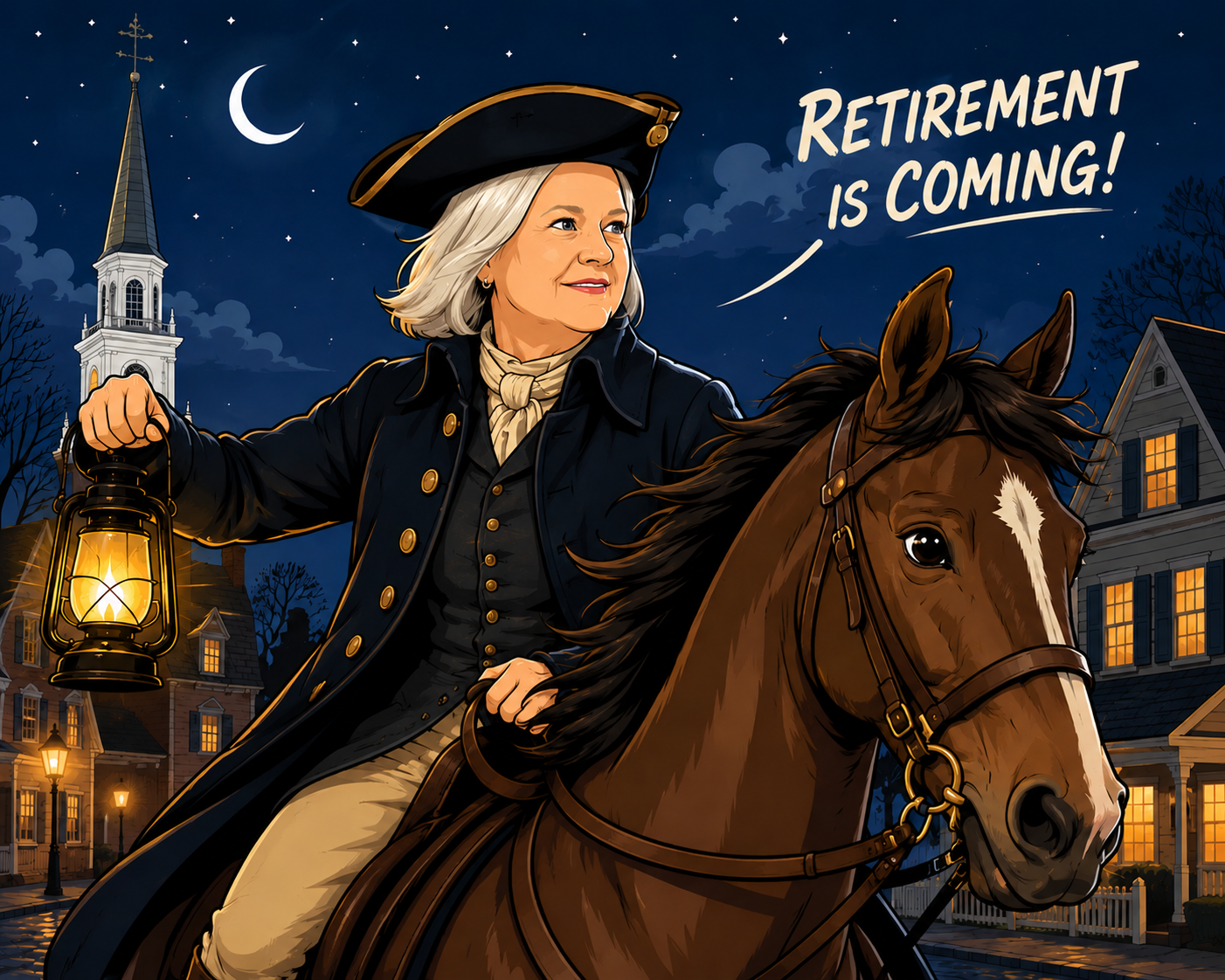
We’ve turned 250! Don’t we look great for our age? The anniversary got us thinking about retirement through the years. We know the pilgrims didn’t have pensions … right. But we do, and we need them. What’s changed! Grab a pony and walk with us through a fanciful review of retirement in the USA.
1776: I’m not old, you’re old.
In 1776, most Americans—19 out of 20—lived in the countryside. Folks lived on farms, in small villages, surrounded by people they'd known all their lives. Growing old didn't mean stepping away from that world. It meant becoming its senior member: the person whose judgment on planting, matchmaking, or town disputes carried more weight.
Life expectancy at birth was low, mostly because so many children didn't survive their first few years. Adults who made it past childhood still faced long odds—historians estimate that more than half of colonial Americans died before age forty. Reaching sixty was rare enough that only about 1 in 20 people got there, and doing so was a real achievement.
Most households held three generations under one roof. Grandparents taught trades and shared (his)tories. They watched young children and passed down decades of hard-won farm knowledge. Grown children did the heavier labor and gave the family more hands, and more security.
Formal retirement wasn’t a thing—with some interesting notes. In 1776, just weeks after the Declaration of Independence was signed, the new Continental Congress authorized pensions for soldiers disabled in the Revolutionary War. It's one of the first formal national level retirement benefits in American history, though it only covered soldiers hurt in the fight.
Paul Revere knew that system well—as an advocate. Spoiler alert: Mr. Revere never collected a pension himself.[i] In 1804, Revere wrote a letter to the War Department on behalf of a female neighbor who had served in the Continental Army disguised as a man. Revere vouched for her injuries and her hardship. In 1805, she became one of only two women known to have received a pension for Revolutionary War combat service.
For almost everyone else, there was something much older than a government pension: a kind of informal retirement, where older workers moved away from the hardest physical labor and took on teaching, managing, and advising instead.
One idea from this era sounds rather modern: in 1797, Thomas Paine proposed a public system to support everyone in old age, not just veterans. It didn't catch on. (Economists! Who listens to them!) In fairness, Paine is hard to read (is it just us?). The family farm and the close-knit village were already doing the job well enough it seems—the momentum wasn’t there yet to reinvent. (Note that for all of the above, if you weren’t a member of a free, land-owning family your work and post-work experience will have differed in key ways).
1826: Country Mouse and City Mouse
Fifty years later, America was still mostly rural. More than 9 in 10 Americans lived outside cities. The multigenerational household was still the backbone of old-age security. But this wasn't just children taking pity on aging parents. It was often a real agreement, worked out by both sides.
Historians studying wills and property records from this era have found surprisingly specific agreements. When a parent handed over the farm to a child, the contract sometimes spelled out exactly how much food, firewood, and care the parent was owed for the rest of their life. In effect, families were writing their own private retirement plans. Land and labor were traded for lifelong support. Grandparents often repaid the favor—raising grandchildren while the middle generation worked the fields.
So: “no formal retirement system” didn't mean “no plan.” The plan was written into the family’s operating and legacy documents.
The city mouse had it differently. About 7 percent of Americans—call it 1 in 14—lived in a town or city in 1820. For those without business interests, land or family close by, old age looked a lot less secure. Two reports give us insight: Massachusetts' Quincy Report (1821) and New York's Yates Report (1824). Both pushed cities away from small cash payments to the elderly poor and toward a newer kind of institution: the almshouse. It's the start of a shift that would define urban old age for the rest of the century. No farm to inherit, no family helping out. The safety net was about to get a lot more institutional—and a lot less comfortable.
Our country mouse/city mouse idea falls apart here because it comments on free individuals and families. Enslaved Americans—about 1 in 6 people in the 1820 census—had no legal right to property, inheritance, or family arrangements like these. Old age depended entirely on an enslaver's decisions, cushioned only by whatever care the enslaved community could offer each other.
1876: We’re closer together
By the mid-1870s, roughly 1 in 4 Americans lived in a town or city. The country was still mostly rural, but the times, they were a-changing. Factories and industry pulled younger workers toward cities and away from the family farm. In this shift communities found new ways to fill the gap once covered by extended family.
Fraternal lodges and mutual aid societies became the era's great invention. Members paid small, regular dues. In return, they got help with sickness, burial costs, and support in old age. By the turn of the century, roughly a third of adult American men belonged to one of these societies. (A THIRD) It was a remarkable, homegrown web of community insurance—finding and filling a need in a new way.
Black Americans had been building networks like this even longer, often against real legal risk. Free Black communities organized their own benevolent societies well before the Civil War—Newport, Rhode Island's Free African Union Society dates back to at least 1780.
Some states saw these networks as dangerous rather than helpful: Maryland made membership in a mutual aid society a felony for Black residents in 1842, worried about ties between free and enslaved communities. By the 1890s, many of the same white fraternal lodges that turned away new immigrants also excluded Black Americans. The Black response was the same one immigrant communities reached for: building parallel societies of their own—a tradition that, like the lodges themselves, outlasted the exclusion that inspired it.
Meanwhile, the Civil War pushed the federal government into paying veterans' pensions on a much larger scale than anything the country had tried before. By the 1880s, these pension payments were flowing into local economies across the North in a very real way. A few employers experimented with pensions, too. American Express introduced one of the earliest formal corporate pensions in 1875. A few years later, piano-maker Alfred Dolge built his own pension fund. His theory: a business should plan for its workers growing older, the same way it plans for equipment wearing out.
Family, lodge, veteran's pension, and this first tentative corporate plan—the pieces were starting to co-exist, and even to stack a little bit.
1926: The First Hints of Leisure
The 1920 census recorded a milestone. For the first time, more Americans lived in cities than in the country. That shift changed what old age looked like for a growing share of the middle class. Fewer families lived on multigenerational farms. More lived in city apartments or—the car had become a thing—in new suburban houses—often a real distance from aging parents.
Employers stepped in to fill part of that gap. Congress sweetened the deal in 1921 and 1926 with tax breaks for pension funds. By 1930, most large companies—especially railroads, utilities, and big industrial employers—offered some kind of retirement plan. It wasn't universal, and it wasn't guaranteed. But for the growing urban middle class, it planted a new idea: old age could be its own chapter of life, planned for in advance, not just a slower version of working life. Let’s face it, leisure has always been a thing—and the concept was starting to trickle down from the upper classes to this new one, in the middle.
You can see the earliest seeds of modern retirement culture here, too. Waterfront havens like Staten Island's Sailors' Snug Harbor were built decades earlier for retired sailors. Places like this hinted at something new—growing old somewhere built just for that purpose, instead of simply staying on the family land.
1926's optimism didn't last. The Great Depression exposed how thin the private pension system really was—many "discretionary" plans were cut or wiped out entirely when companies failed, and by 1932 only about 5 percent of elderly Americans were actually collecting a pension of any kind. Congress and FDR answered with the Social Security Act, signed into law on August 14, 1935—the country's first truly national old-age program, paid for through payroll taxes rather than an employer's goodwill or a company's survival. It's the single biggest addition to the retirement toolkit in this whole 250-year story. In America, we love our Social Security ❤️.
The 1920s and the 1970s feel so different that it’s hard to believe they belong in the same century. Prepare yourself for an abrupt jump. (ERISA, anyone?)
1976: Retirement in the lexicon
By the mid-1970s, roughly three out of every four Americans lived in urban or suburban areas. The extended, under-one-roof household was far less common than it had been a century before. Grown children often lived in a completely different city than their parents. Something had to replace the built-in support network the family farm once provided—and by 1976, two big systems had grown up to do exactly that: a maturing Social Security system, now the bedrock of most Americans' retirement income, and a private pension system Congress had just given real legal teeth.
President Gerald Ford signed the Employee Retirement Income Security Act—ERISA—into law in 1974. It didn't require any employer to offer a pension, but for the ones that did, it set real rules for the first time: funding standards, vesting rights, and a federal backstop if a plan failed. In 1976, the traditional pension—a set monthly check for life—was still the standard. The 401(k) wouldn't exist for two more years. Coverage still depended heavily on where you worked and whether your job was unionized, but for a large and growing share of Americans, retirement had become something new: a real, plannable, even enjoyable stage of life, built on the combination of Social Security and an employer pension.
Both of the "big things" behind 1976's retirement security had real gaps for Black and immigrant families. Social Security's 1935 design excluded agricultural and domestic workers—jobs that made up the majority of the Black workforce at the time—leaving roughly 65 percent of Black workers nationally, and up to 80 percent in parts of the South, outside the system entirely.
Those exclusions were repealed in the 1950s, but the damage to lifetime earnings and benefit levels carried forward for decades. On the pension side, coverage depended heavily on union membership and steady work at a large employer—categories Black workers were often shut out of by ongoing job discrimination.
1976 was also a new moment for many immigrant families: the Immigration and Nationality Act of 1965 had just ended a 40-year quota system that heavily favored Northern Europeans, opening the door to far larger and more diverse immigration. A decade in, many of these families were still establishing themselves—too recently arrived to have built the steady, unionized, multi-decade careers that pension coverage was built around.
On a brighter note—for those who could afford it, a smaller but colorful trend added a new option to all that financial infrastructure: the planned retirement community. Del Webb's Sun City, Arizona, opened on January 1, 1960, as the country's first age-restricted, active-adult retirement community—golf courses, clubhouses, and more than 100,000 curious visitors on opening weekend alone. A good friend of ours just signed up for a Boommate living arrangement. Senior community lifestyles are going strong.
2026: Same Question, New Tools
Two hundred fifty years in, the core question hasn't changed. How do we provide for dignified, even comfortable, lives for our beloved American workers and families as our working years slow down?
We won’t (re-) recite the stats on retirement savings access and security. In a universe of much success, retirement success is definitely not universal; current gaps, risk and shortcomings are well understood.
The toolkit is key—and it is changing faster than ever. The family farm, the fraternal lodge, the company pension, Social Security, and maybe even the planned retirement community—each was, in its time, one of the best available answers to our retirement security question.
We hate to give this story a moral, but it is a story, so here goes. In every era, no single answer did the whole job alone. The family farm needed the village around it. The fraternal lodge worked alongside veterans' pensions. Social Security and the company pension worked together. Today's answer follows the same pattern: not one tool, but a tighter, closer-woven network, built from a handful of proven elements.
Social Security as a bedrock. It's the one piece nearly every worker can count on, regardless of employer, industry, or income.
Employer-sponsored retirement plans. Pensions and 401(k)s remain a key layer built on top of that bedrock, for the workers whose jobs come with one.
State Auto IRA programs—and perhaps a Federal standard, closing the gap the first two leave behind—a formal way to save for the millions of workers whose jobs don't come with a plan at all.
Automatic enrollment at the point of pay, which makes saving the default instead of a decision nobody quite gets around to.
Automatic escalation, which lets contribution rates quietly rise as paychecks do.
A national retirement savings clearinghouse, helping people find and consolidate old accounts instead of losing track of them across job changes, or worse—losing them to cashouts and escheatment.
Retirement-convertible child—and education-savings accounts, so the habit of saving doesn't have to start from zero at someone's first job.
None of this is really new, even if the tools are. Automatic enrollment is just the family farm's old built-in default, rebuilt for a payroll system instead of a plot of land. It's a very old American instinct, wearing modern clothes: weave a tight enough net that nobody has to depend entirely on luck, geography, or the generosity of a lifetime of employers to be secure once they've earned some rest.
[i] Paul Revere served as a Lieutenant Colonel in the Massachusetts state militia, not the Continental Army. His service ended under a cloud when he was court-martialed (then exonerated) over his conduct at the disastrous 1779 Penobscot Expedition. The first Revolutionary War service pension act (1818) covered only Continental Line veterans — soldiers who'd served under Washington's regular army — and required proof of financial need. Revere died in 1818, the year that act passed. However, he would not have been eligible for a pension under this act. Revere served in state militia, not the Continental Line, and by then he was a wealthy industrialist running a copper mill. Even if covered, he would not have qualified under the "reduced to indigence" standard the act required. State militia veterans finally became pension-eligible under the Act of 1832 — 14 years after Revere died.