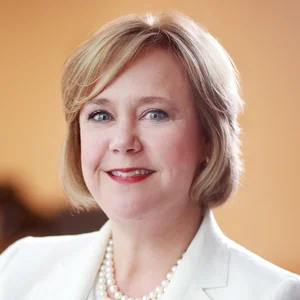

A conversation with H&R Block's John Thompson.
Our retirement system was built for a worker with a steady job, a regular paycheck, and a plan at work, but many Americans don't fit that picture. John Thompson works with those Americans up close. As Vice President, Financial Services at H&R Block, he leads products built around real household finances, drawing on nearly 30 years in tax and financial services and his time as Chief Program Officer at the nonprofit Financial Health Network. This year, H&R Block says it helped families enroll in about 2 million Trump Accounts, and now it is gearing up for the Saver's Match and TrumpIRA.gov in 2027.
What We Learned
Tax time is a rare window. It's one of the few moments when someone sees a household's whole money picture, and can start a conversation about it.
Access is improving. Staying the course is key. State Auto IRAs, TrumpIRA.gov, and Trump Accounts mean more people have an account. Now the job is getting money in and keeping it coming.
Keep it simple, but don’t create a throwaway moment. Do the hard work behind the scenes so saving feels easy. Just remember that new investors are taking on real risk.
Join our Convo:
From tax time to financial health
John, tell us about your current role and focus.
I lead the financial services business at H&R Block, and that means consumer banking, lending, and related financial products. H&R Block is mostly known as a tax company. We serve maybe 17 or 18 million customers each year for taxes, and a little under 5 million for financial services.
Historically, our financial products were tied to tax time. How do I get my refund? How do I use it? How do I avoid check-cashing fees? Increasingly, I'm shifting the business toward products that improve our clients' financial health, across the framework we use: spending, saving, borrowing, planning, and earning. My past work has driven me toward a focus on the customer outcome over time. If we center on that, we'll have a really great business, too.
The connection to retirement is fairly straightforward. It's where tax policy, financial incentives, household circumstances, and the tax refund all meet.
A system built on assumptions
We met in the retirement security space. What are you seeing and learning that might help us in 2026?
Part of what I'm learning is that the system is built around a whole series of assumptions: stable employment, workplace benefits, regular payroll contributions, the ability to save consistently. Of course, those assumptions are not always true. In many, many cases, they're not. There's variable income, multiple jobs, periods of self-employment, and lots of competing demands.
The retirement community works on a lot of access, product, and policy questions. But direct interaction with the customer often isn't part of the conversation. That feels like a missing link. How do you reach the customer and help them, especially beyond access?
Tax time is interesting because we have a fairly complete picture of the household. We might have some money to work with. The customer has decisions to make about a refund. We can see whether you're in your retirement plan at work and whether you're getting your full match. In theory, we can have a conversation about all of that. That's harder to do if you're an asset manager, a recordkeeper, or even a payroll company. So I'm increasingly thinking: Access we've got to solve, but how can we sustain the behavior?
There are a lot of curbs along the way: things you can do, have to do, and cannot do. They shape the experience, and it can end up less friendly, less simple than it might have been.
Well said. I talk to our teams about this all the time. We have to deeply understand all the rules, all of them: federal, state, local, product, tax policy. And then we got to take all that stuff and get it out of the way. A customer may be trying to make a good choice. Or maybe they're just trying to finish. How do we help them make a good choice?
"Plans and everybody else": where state Auto IRAs fit
Many of your clients are self-employed or work for small employers. How do you see state Auto IRA programs fitting into this ecosystem of plans and everybody else?
Yes. Our customer base isn't really a low-income customer base. By economics, age, and financial health, it really matches America. So the country's challenges are the challenges we see.
By our own assessment, a majority of our customer base does not have access to a workplace plan that we can identify. We know our data there isn't perfect, but this is what we see.
And roughly half the customer base saved nothing for retirement last year. Those are distinct measures, but that's not going to work for our clients or for the country. We have an access problem and a behavior problem to get after.
When I re-entered the retirement community about four years ago, the people on stage were the people building state Auto IRA programs. Look at what they had to figure out. How do I manufacture a product? Distribute it? Make it sustainable? Keep savings going beyond enrollment? I was fascinated.
H&R Block serves about 2.1 to 2.5 million small business customers: gig workers, sole proprietors, and more. For a while, I thought we could just use the state programs to solve the access problem. If someone doesn't have an IRA, can we just sign them up? Then I learned there are multiple programs, each run a little separately, and that would be challenging for us. Still, it's one of our tools. We can encourage a small business to enroll and help get its employees signed up. And if a customer already has access, they don't need a different account. By and large, those are amazing accounts.
But now we have to go teach 60,000 people what those are. What's OregonSaves? What's CalSavers? What role do they play in my client's financial life? It isn't necessarily something our tax professionals were studying. And we'll have to do that again with TrumpIRA.gov. I was just so excited about the state programs. They covered the hardest problem: getting started.
TrumpIRA.gov and the Saver's Match: a new access equation
We've got 17 Auto IRA programs passed so far, and a city one coming, but a majority of states still don't have them. TrumpIRA.gov is meant very specifically to cover people who aren't covered today. How are you thinking about it?
Think about a client saying to us, "I don't have an account," and us being able to say, "Yes, you do. There are many available to you, including one that's available to everybody in the country." That changes the access equation a lot, as long as the process is simple. We suspect many customers will want to open an IRA as part of filing their taxes, so they can contribute, get the potential tax benefit of a traditional IRA, and potentially claim the Saver's Match. So it's going to have to be super easy.
Think about the message we're about to share with our entire customer base: The Saver's Match is coming. You must have an account. You must start saving. If you don't have an account, here's where you can get one. Now we have something specific to say, instead of "Go find your local investment provider." And if and when we launch our own program, which we're working on, we'd expect to be part of that marketplace, too.
Over a decade, maybe we're working our way toward a point where access to an account isn't the biggest challenge. Now we can get to the next one: knowing I have an account, and figuring out how to make a contribution.
We suspect your 2027 and 2028 tax years are going to be unlike any other in recent memory.
We're trying to make it that way. At our company convention, we talked with field leaders about what the Saver's Match is, how it's different from the Saver's Credit, and who qualifies.
We know awareness is low. Our job is to tell everyone, even people who don't qualify, because their family, friends, or neighbors might. We're gearing up to get as many people as possible ready for the match in 2028, when the money starts flowing. We're still waiting on the details, but the details will be the details. We know this program is going to exist, and we know we have a game-changing opportunity to help people.
Like the Saver's Credit, the match will mean filing a Form 1040 and a new form, potentially Form 8880-A to claim and direct the Saver’s Match to a destination. That makes taxpayer support, and outreach to people who don't see themselves as taxpayers, incredibly important.
They'll get to see themselves as savers and investors, too. That part gets me really excited, because we can put product managers and designers on it and try to turn that complexity into something simple. You don't have to fill out the form. We'll figure out how to fill out the form.
It does make me anxious, though. We've seen other well-intended policies get wrinkled up in complexity. The advance EITC was incredibly complicated and hard to use. The Saver's Credit was also complicated to claim. If you're not on the front end helping somebody with their taxes, it's just complicated. So I want to deploy everything we've got, both as H&R Block and as a tax industry working on retirement.
Trump Accounts: 2 million accounts, and 99% in our offices
At the other end of the spectrum, you've done a lot of work on Trump Accounts. How's that going?
When the enrollment process landed on one that included a tax time moment, I knew we had a really important job to do. We had to build it into multiple software platforms, train our whole field, and figure out how to talk to clients about an account for their child. The name was divisive, too. We lost customers because of this. We got some negative feedback about the name. How do you describe it? What do you call it? I don't mean that in political terms. I mean practical terms. You're interacting with all of America, and everybody has an opinion.
But the outcomes were really amazing. Thirty percent of all the children we saw, ages zero to 18, signed up for an account. For children eligible for the $1,000 deposit, 90% signed up. And for families who worked face to face with a person in one of our offices, we hit 99%.
Wow!
You can't get 99% of people to do anything, much less something good. We checked that number many times, and it held up. I think we helped families enroll in a little over 2 million accounts during tax season. We really punched above our weight.
Then the program shifted toward automatic enrollment. Now we're both focused on completing Form 4547 and also on asking: Do you have your account? Do you have the app? Have you shared it with family so they can contribute? It's about making sure clients succeed with an account they now have, and may not know they have. [Editor's note: Automatic enrollment opens the account, but it requires a claiming action to transition to family control and receipt of third party contributions. So, families of eligible children born from 2025 through 2028 must still elect the $1,000 by filing Form 4547, through the Trump Accounts app or website, or their IRS online account.]
Simple, but not a throwaway moment
John: What haven't we covered that's on your mind this year?
This is one thing: How do we build on a win, something we can really be proud of with Trump Account enrollments, and turn it into a financial health conversation, of which retirement is a part? We're also wrestling with how much unsecured debt consumers carry right now. That gets in the way. And I think there are fascinating stories in H&R Block's data that I'd like to make accessible to researchers and policymakers.
With Trump Accounts, the Saver's Match, and TrumpIRA.gov, we also need to tell a compelling story about their impact while they're still small. They will start small, and they will become meaningful over time. We need to not lose sight of the successes, even if they don't have 10 figures in them.
One more thing. With IRAs at tax time and the Saver's Match, we're introducing people to financial markets they may never have been part of. I still watch people struggle with the basic questions for opening an investment account. What's my risk tolerance? I don't know. What's my investment experience? Bad. Those questions can be super scary and get people to say, "Ah, maybe I shouldn't do this."
So how do we make getting someone into the market simple, but also appropriate? It shouldn't be a throwaway moment either, because you are taking risk. Half of our customers aren't saving. What happens if we solve all that? Now we've put people into a system they need to be competent in and able to fend for themselves in. Balancing simplicity with respect for the market is really important to me.
So well said, John – thank you for joining us!.
If you’d like to connect with John you can reach him on LinkedIn. You can follow H&R Block here.