
Primary Drivers of Total Fertility Rate Decline in Developed Countries – June 2026
What the Evidence Shows
Important note: This article was developed using Claude, an AI assistant made by Anthropic. All facts and figures have been drawn from cited sources and should be independently verified before formal citation. We like to ask good questions, and we found this recap interesting. The question? What are the primary factors cited by the leading authorities as the drivers of developed countries’ Total Fertility Rate decline. // Massena Associates LLC
Primary Drivers of TFR Decline in Developed Countries
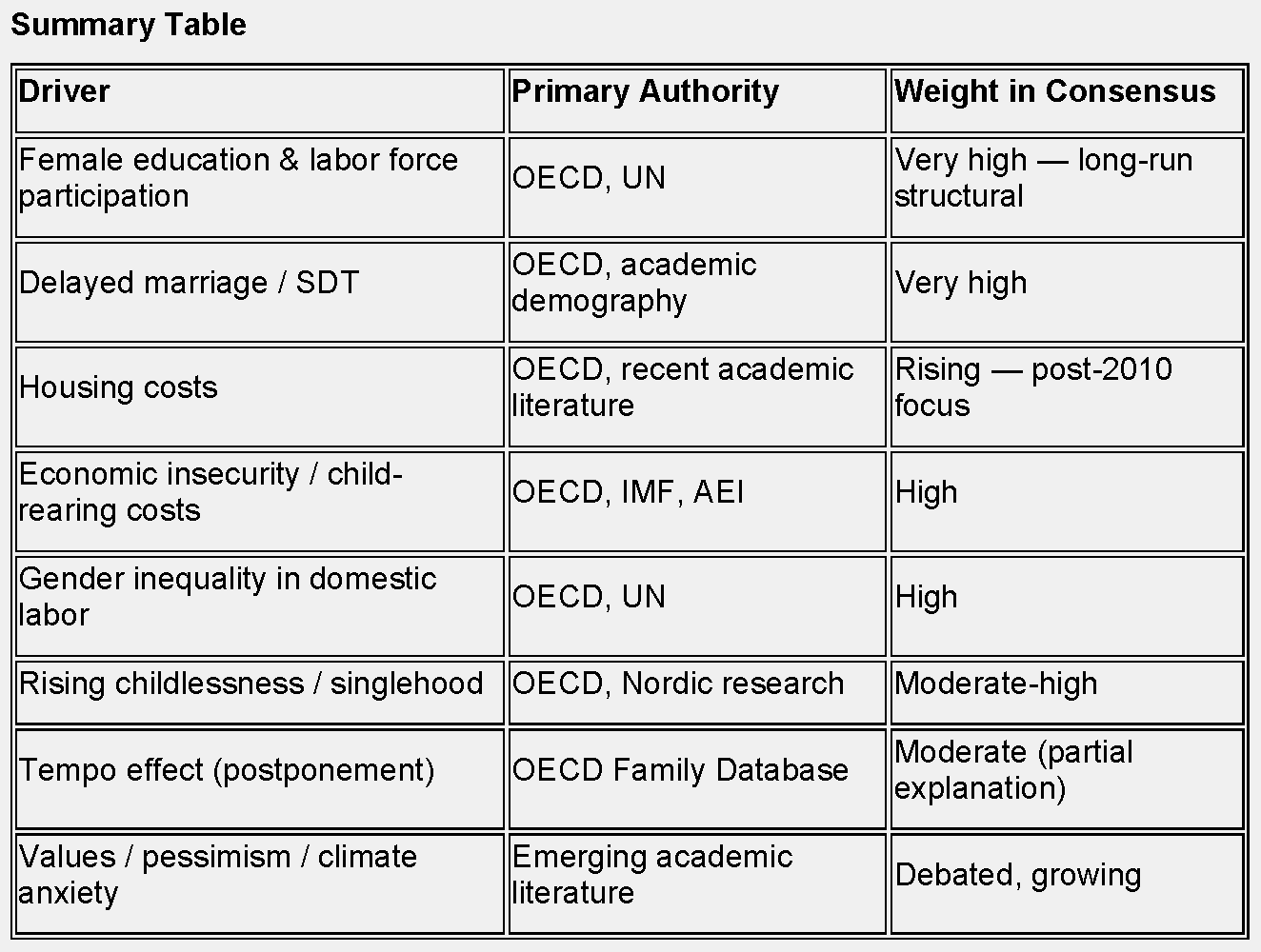
The authoritative consensus — anchored by the OECD's Society at a Glance 2024, the UN's World Fertility 2024, and peer-reviewed demographic research — converges on roughly eight interlocking driver categories. They are not fully separable; many reinforce each other.
1. Women's Education and Labor Force Participation
This is the most consistently cited structural driver across all authoritative sources. Access to contraception, increasing female education, time needed to establish oneself in the labor market, and barriers to balancing work and family life have all played a role in declining fertility. OECD
Higher education lengthens the time before women enter the workforce, delays household formation, and raises the opportunity cost of leaving employment to have children — particularly where work and childrearing are structurally difficult to combine. This doesn't mean education causes childlessness; it delays and compresses the childbearing window, which reduces TFR even when desired family size is unchanged.
A key cause of ultra-low fertility in Korea, for example, is the high opportunity cost of having children. Rapid economic development and higher access to education have enabled women to pursue increasingly rewarding careers, but long hours, insufficient protections against workplace discrimination, and rigid gender norms make combining career and motherhood exceptionally costly. Oecdecoscope
2. Delayed Marriage and Household Formation ("The Second Demographic Transition")
Demographers group much of what's happening under the "Second Demographic Transition" — a shift in values and life sequencing in post-industrial societies that produces later marriage, more cohabitation, more childlessness, and smaller families. Births increasingly occur at later ages, with an average age at first birth across the OECD of 30.9 in 2022, compared to 28.6 in 2000. OECD
With less than 3% of births outside marriage in 2020, fertility rates in Korea, Japan, and Türkiye remain strongly associated with marriage — meaning that in those countries, declining marriage rates translate almost directly into declining birth rates, with no offsetting nonmarital fertility to cushion the fall. This makes Japan and Korea especially exposed. OECD
3. Housing Costs and the Inability to Form Independent Households
This is a relatively newer entrant to the consensus, gaining significant weight after the post-2010 fertility decline continued even as economies recovered from the financial crisis. A scan of high-ranking population studies journals published between 2021 and 2024 found that while 62 studies focused on economic indicators like employment and income, only four focused on housing — a relative shortage surprising given recent trends in rich societies that should place housing-fertility links at the center of demographic attention. nih
The OECD now flags it explicitly: financial support toward families, especially when linked to housing, is increasingly important. The mechanism is both direct (families need stable space before having children) and indirect: the lack of affordable owned housing delays the start of childbearing, reducing completed fertility, and even temporary housing unaffordability might have long-lasting effects on the age pyramid. OECDrepec
4. Economic Uncertainty and the Cost of Raising Children
Personal choices on having a child depend on a wide range of factors, such as economic and financial security and the costs of raising children. This operates at multiple levels: general macroeconomic insecurity (which spiked sharply after the 2008 financial crisis and again post-COVID), student debt, childcare costs, and the direct expense of raising children through education and into early adulthood. OECD
Lyman Stone's research at AEI identifies specific structural barriers in the US context: increased young adult debt service costs due to student loans and decreasing young adult homeownership due to rapidly rising housing costs. The problem, he notes, is not that Americans don't value children — it's structural barriers to achieving desired family size. AEI
A related finding from academic demography is that subjective economic narratives matter too: economic uncertainty has been proposed as a central explanation for fertility decline or stabilization during the Great Recession and its aftermath, operationalized through objective indicators of labor-market situations such as temporary contracts or unemployment. nih
5. Gender Inequality in Domestic Labor — The "Stalled Revolution"
One of the more counterintuitive findings in modern demography: countries where gender equality is highest (Nordics) often have higher fertility than countries where traditional gender roles are most entrenched (Japan, South Korea, Southern Europe). The mechanism is that in traditional-role societies, women bear the full double burden of paid work and domestic/childcare labor, making the cost of having a second or third child prohibitive. Where fathers share caregiving equally, the marginal cost of additional children falls for mothers.
The OECD identifies this as a core lever: encouraging an equal distribution of caregiving and household responsibilities between men and women can improve women's labor participation, support families, and encourage childbearing. ReliefWeb
6. Declining Partnership Formation — Singlehood, Childlessness by Choice
Separate from delayed marriage is a structural rise in permanent childlessness and chosen singlehood. One reason for declining Nordic fertility is an increasing number of couples who voluntarily or involuntarily remain childless. Cross-nationally, the share of people who report wanting zero children has risen, particularly among younger cohorts in high-income countries — though it remains a minority position. United Nations in Europe
7. The "Tempo Effect" — Postponement vs. Genuine Quantum Decline
A technically important distinction authorities make: some of the measured TFR decline reflects when women have children (tempo) rather than how many (quantum). In Austria, Canada, Czechia, Estonia, Ireland, Korea, and Lithuania, there is a large difference between the standard TFR and the tempo-adjusted TFR (0.4 points or more), which suggests that recent declines might be attributable to delayed childbirth and may lead to a potential future rebound as postponed births eventually occur. OECD
This is a real source of optimism in the data — but the tempo-adjusted rate is also declining in most countries, meaning true quantum decline is occurring alongside postponement. In Bulgaria, Hungary, and Portugal, the difference between the adjusted TFR and the regular TFR is 0.1 or less, suggesting that birth postponement might not significantly influence TFRs in those nations — their decline is largely real, not an artifact of timing. OECD
8. Values, Pessimism, and the "Shadow of the Future"
The most contested driver, but increasingly present in the literature. Academic research has shown that narratives of the future affect fertility — pessimistic views about the future (economic, environmental, social) depress intended and actual family size. Climate anxiety, in particular, has emerged as a reported factor among younger cohorts in surveys, though its independent causal weight remains debated. nih
Separately, the UN's World Population Prospects 2024 frames gender equality and women's empowerment as both a driver of decline (where empowerment was previously suppressed) and a potential stabilizer: gender equality and women's empowerment help to counter rapid population growth or decline — meaning that in low-fertility countries, policies that reduce the conflict between work and family for women are among the few levers with demonstrated positive effects. ReliefWeb
The OECD's bottom line captures the synthesis well: family policy measures and improved work-life balance are not enough to overcome the demographic challenges on their own — the forces driving decline are structural, deep, and partly self-reinforcing across generations. Dsv-europa